In 1839, John William Donaldson showed that the letters of the alphabet are grouped by their phonetic and articulatory features:
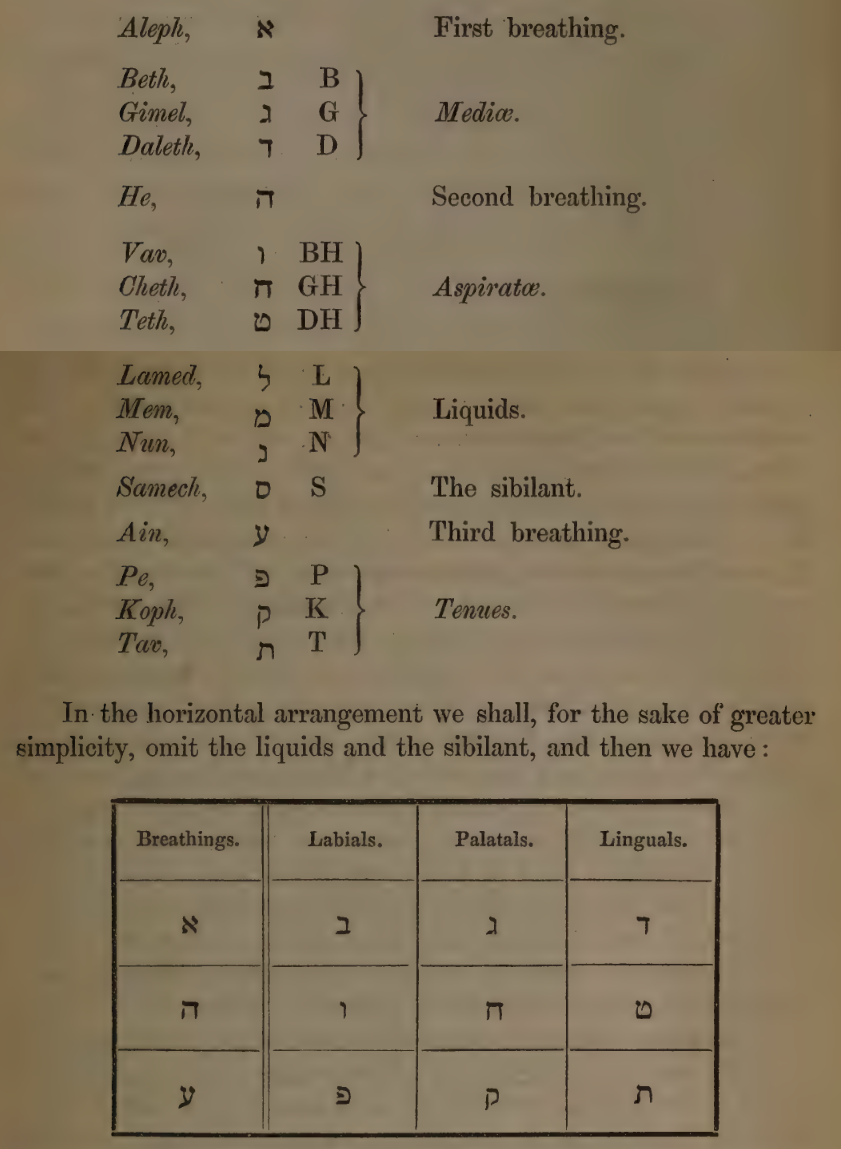
The way Donaldson transliterates ו ,ח, and ט is not necessarily accurate, but this does not significantly affect the overall pattern.
He hesitated to include a row for the letters he called “liquids,” apparently unwilling to alter the traditional order. This is somewhat self-contradictory, since he goes on to state — probably following Tacitus — that “these sixteen letters constituted the original Greek alphabet” (sedecim litterarum formas).
In 1883, Isaac Taylor reviewed various explanations of alphabetic order, including Donaldson’s. Unlike Donaldson, Taylor did not hesitate to include the liquids. He moved m among the other labials and switched the positions of r and k to demonstrate that the underlying structure is still largely present and requires only minor adjustments to become fully consistent:
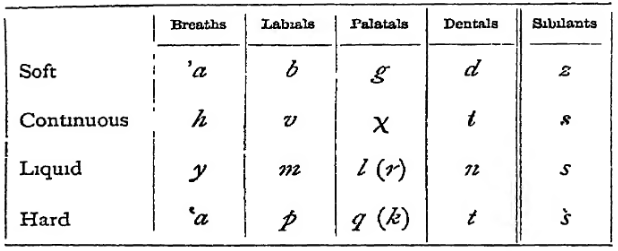
Here Taylor simply transliterated the earlier forms. His treatment of the “sibilants” is less clear. Given the reference to the original sixteen letters, it might have been more natural to treat ט as a “continuous” sound (like the Greek θ) and exclude the others.
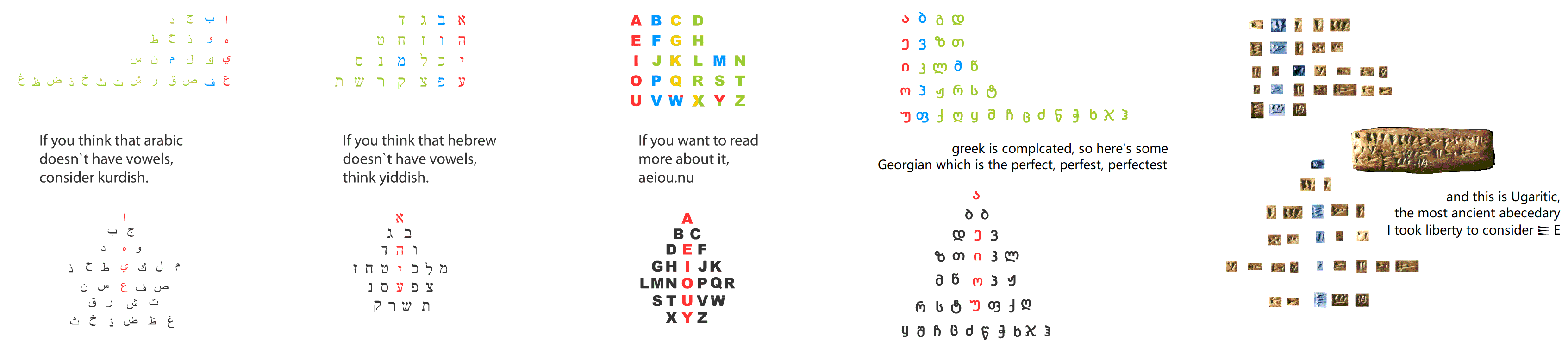
What I propose here is an explanation for why the articulatory structure appears distorted in alphabets:
There is a second, independent structure superimposed on the first. This second pattern has received surprisingly little attention in the literature, even though it is particularly clear in the Latin alphabet used by most of the world today: it places L in the leftmost position and R in the rightmost position. This left–right framing may also explain why the distortion in the articulatory structure is strongest among the sonorants (formerly called liquids).
Both structures can already be observed in the oldest known abecedaries. This naturally raises questions that I am not yet prepared to answer definitively. Since M is misplaced in every alphabet I have examined, it seems that the order of the alphabet was modified before it spread.
Beyond its possible pedagogical value — making it easier for children or adult learners to acquire an alphabet or master a foreign script — this dual structure suggests that we may need to reconsider certain conventional transliterations of Ugaritic letters. This is supported by o.6 in KTU 5.14:
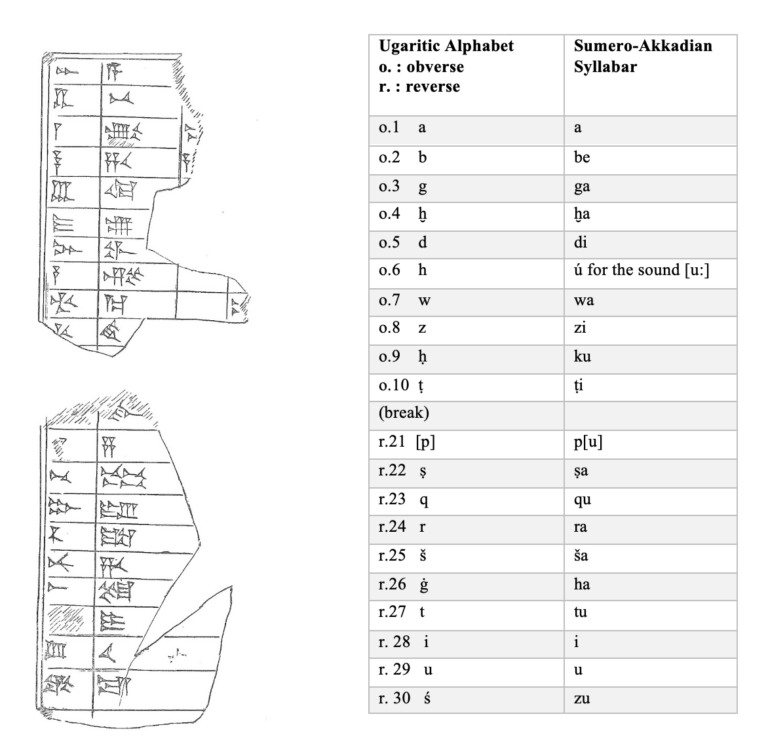
It may also indicate that the
Ugaritic sign 𐎓 represents the vowel o,
while the Sumerian sign 𒌋 represents the consonant v,
making both a likely predecessor of ו, which represents both sounds in Hebrew.
while the Sumerian sign 𒌋 represents the consonant v,
making both a likely predecessor of ו, which represents both sounds in Hebrew.
.png)
References:
Donaldson, John William. 1839. The New Cratylus; or, Contributions Towards a More Accurate Knowledge of the Greek Language. Cambridge: J. and J. J. Deighton; London: John W. Parker.
Tacitus. Annales. Book 11, Chapter 14.
Taylor, Isaac. 1883. The Alphabet: An Account of the Origin and Development of Letters. 2 vols. London: Kegan Paul, Trench & Co.
Virolleaud, Charles. 1957. Le Palais Royal d'Ugarit II: Textes en cunéiformes alphabétiques des archives est, ouest et centrales. Paris: Imprimerie Nationale; Librairie C. Klincksieck. (Mission de Ras Shamra, vol. 7).